

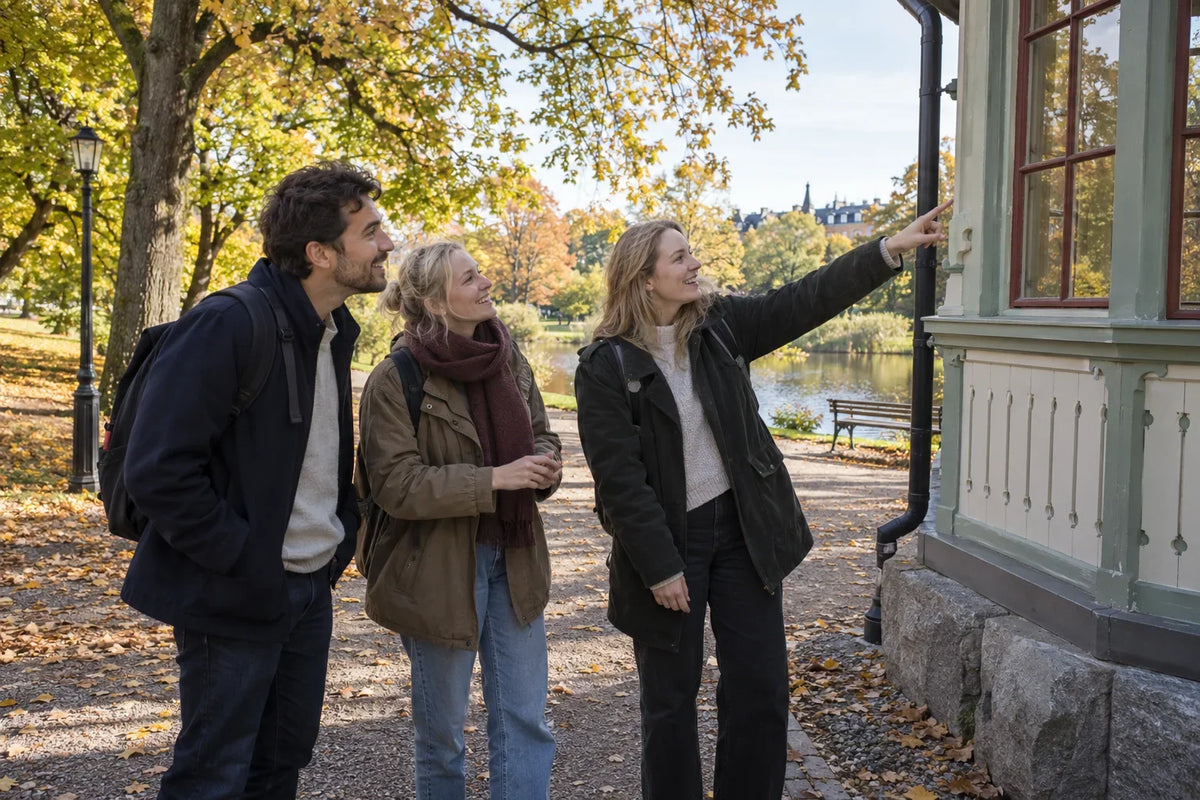
Walking games for adults don't need a scoreboard or a game master. A small shared task can be enough for you to discover more of a familiar route. Here are four standalone ideas you can try on an ordinary walk. They are not part of the purchased Mysteriejakt games and do not require a booklet. Adapt them to the location and let conversation be more important than someone winning.
The mysteries in this guide


In this guide
Detail spotting: find something the others missed
Choose a defined area you can look at without entering private property, such as a building facade or a section of a park. Everyone quietly chooses a visible detail. Then describe it step by step until the others find the same thing. Start broadly, such as material or color, and become more precise if the group gets stuck.
Change who describes after each round. The fun is that you see different things in the same environment. Stick to things that can be observed; no prior knowledge of architecture or history is needed. Stop in a place where you are not blocking others.
Memory stop: what did you actually notice?
Before a short stretch, agree that everyone should observe their surroundings. Then stop safely and let one person ask a question about something you passed: how many windows did the gate next door have, what color was the bench, or what was next to the sign? The question should be about something that could reasonably have been seen.
Compare the answers before checking them if possible without going out of your way. No one should have to run back, step into the street, or look back to participate. Change who asks the question and keep the rounds short so that it still feels like a walk.
Theme walk: choose one thing to look for
Agree on a theme for a part of the walk: circles, blue details, old fittings, or things that seem to have changed use. Everyone helps find examples. If a theme does not suit the area, change it without having to choose a winner.
Afterward, you can ask what the theme made you see that you otherwise would have walked past. In an older urban environment, it can also create curiosity about history. The guide to historical details in Gamla stan gives examples of how observations can become questions to investigate further.
Fact or interpretation: build a reasonable theory
Choose something you see and let one person state a certain observation, for example that a wall has a blocked opening. The next person gets to suggest a possible explanation. The group then distinguishes between what you know, what you think, and what would be needed to check the theory.
The game is not about making up a dramatic story and making it true. It is precisely the difference between evidence and assumption that is the task. If you want to write down a question, you can investigate it in a reliable source after the walk, without interrupting the entire outing to search on your phone.
When you want to go from a small game to a full case
The free ideas above give an ordinary walk a focus. A purchased city mystery, on the other hand, adds a coherent fictional story, materials, and tasks at specific locations. There are mysteries in Gamla stan, Haga, Örebro city center, and Wadköping.
That setup requires the right booklet on site and a mobile phone with internet access for the Archive. Order the booklet in advance if you are shopping online. To compare what you get from an ordinary walk and a more planned activity, there is the guide to walking around the city on your own.
If you want a ready-made task list for your own game? Here are five tasks for a treasure hunt for adults. They are independent of our purchased mysteries.
The mysteries in this guide
Frequently asked questions
Do we need to buy anything for the walking games in the article?
No. The four suggestions are standalone observation games that you can try on a regular walk without a booklet or special equipment.
Are the games clues from the Mystery Hunt games?
No. They are their own little activities and do not reveal any clues or solutions from the purchased city mysteries.
Do we have to compete or keep score?
No. You can help each other and switch roles between rounds. The activities are designed to make the walk more of a group experience, not to require timing or competition.
Which walking game is easiest to start with?
The detail hunt only requires you to choose something visible nearby. One person describes a detail step by step until the others find it. Then switch who is describing and choose a new detail.
How do we adapt the games if we have different levels of attentiveness or speed?
Keep the rounds short, switch roles, and let the group help each other. Choose themes and details that everyone can spot from a safe place, without any requirement to run or be the first to finish.
What distinguishes the free games from a purchased city mystery?
The games are short, standalone observation exercises. A city mystery has a continuous fictional story, its own materials, and clues at specific locations, and uses the booklet together with the Archive on your phone.


