


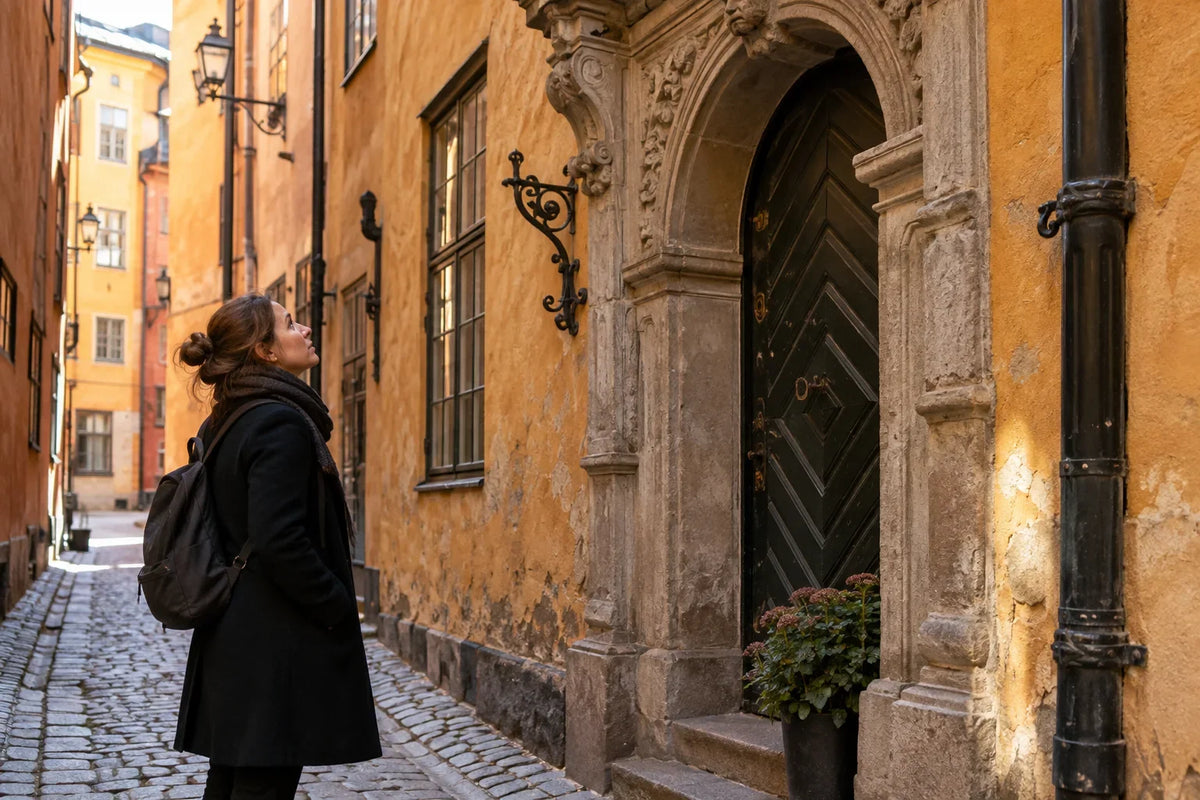
Gamla stan can be experienced in two ways: as a series of well-known sights or as a place full of small differences to notice. This guide is for the latter kind of walk. Look at the street names, how the alleys change in width, and how the doorways differ from one building to the next. No prior knowledge is needed, but it helps to distinguish between what you actually see and the history you need to read up on.
The mystery in this guide

In this guide
Read the street names as questions
Köpmangatan is one of Stockholm's oldest named streets and has roots in the Middle Ages. Names like this can be the start of a conversation about how a city has been used. Write down a question during the walk and look for a reliable source afterwards, instead of letting a street name be the whole explanation.
Västerlånggatan and Österlånggatan are well-known thoroughfares, but a short detour can change how you perceive the area. Stop where there is space without blocking a doorway or disturbing residents. This text suggests things to observe, not that you need to follow a specific route.
Compare the scale of the squares and alleys
Stortorget is described in Visit Stockholm's materials as Stockholm's oldest square. The contrast between an open square and a narrow passage is clearly noticeable when walking. Look at how the movement changes: where do people walk through, where do they stop, and how are the ground floors used?
Mårten Trotzigs gränd is known for its narrow passage, around 90 centimetres at its narrowest point according to Visit Stockholm. It is a different kind of space than the square. Judge for yourself whether the stairs, crowds, and surfaces suit the group; you do not need to take every passage to have an interesting walk.
Look at the doorway before the next shop window
A doorway can give more to think about than you first believe. Compare the shape of the stone, the iron fittings, the wood, the wear, and how the entrance is set in the facade. Two neighbouring houses may look alike from a distance but have completely different details when you get closer.
Be careful about dating a building based on its appearance alone. An old neighbourhood can contain many layers of additions and renovations. Rather say that you see a certain material or a certain shape than that you know what year something was put in place. For a historical task, a source that actually covers the building is needed.
Make the observations together
Try a simple task: each person chooses a detail that the others did not see at first. Then everyone describes what they can actually observe and what is an interpretation. An unusual fitting is an observation; the story of why it is there is a question to investigate.
If you want more free ideas, there are walking games for adults. For a broader plan for the visit, there is the guide to things to do in Gamla stan. Neither shop opening times nor access to buildings should be assumed to be included in an outdoor walk.
Choose a mystery when you want a story to follow
The Mystery in Gamla Stan is another way to explore the area: you get a fictional case, a booklet, and tasks that you solve with the help of the materials and the environment. It is a game, not a documentary story about a real murder or a staffed historical tour.
The observation suggestions provided here are standalone and do not reveal the game route or any solutions. If you are going to play, follow the instructions in the purchased booklet. Read the guide before starting in Gamla stan for practical preparations and order the materials well in advance.
Sources and current visitor information
The mystery in this guide
Frequently asked questions
Are the historical facts the same as the mystery's story?
No. The city's history and the game's fiction should be kept separate. The Mystery in Gamla Stan is a fictional murder case that you solve on site, not a documentary account of a real crime.
Can we follow the observation suggestions without buying anything?
Yes. The suggestions are for an independent walk in public places and are not excerpts from the purchased mystery. Any admission to businesses must be arranged separately.
Are all alleys suitable for everyone?
No. Uneven surfaces, stairs, and crowds can affect what works. Assess the conditions on site and check accessibility information if anyone needs a special accommodation.
Can we determine a building's age just by looking at the facade?
No. Buildings may have been rebuilt and renovated in several stages. Describe the material or shape you see and check the dates in a source that actually concerns the building.
How do we make detailed observation a group activity?
Let everyone choose a visible detail that the others did not notice at first. Then compare what you can certainly observe and what explanations still need to be investigated.
Do the observation suggestions reveal solutions from the purchased mystery?
No. They are independent suggestions for an independent walk. If you play The Mystery in Gamla Stan, you use the facts and instructions from the purchased booklet, not the suggestions in this guide as the game route.