

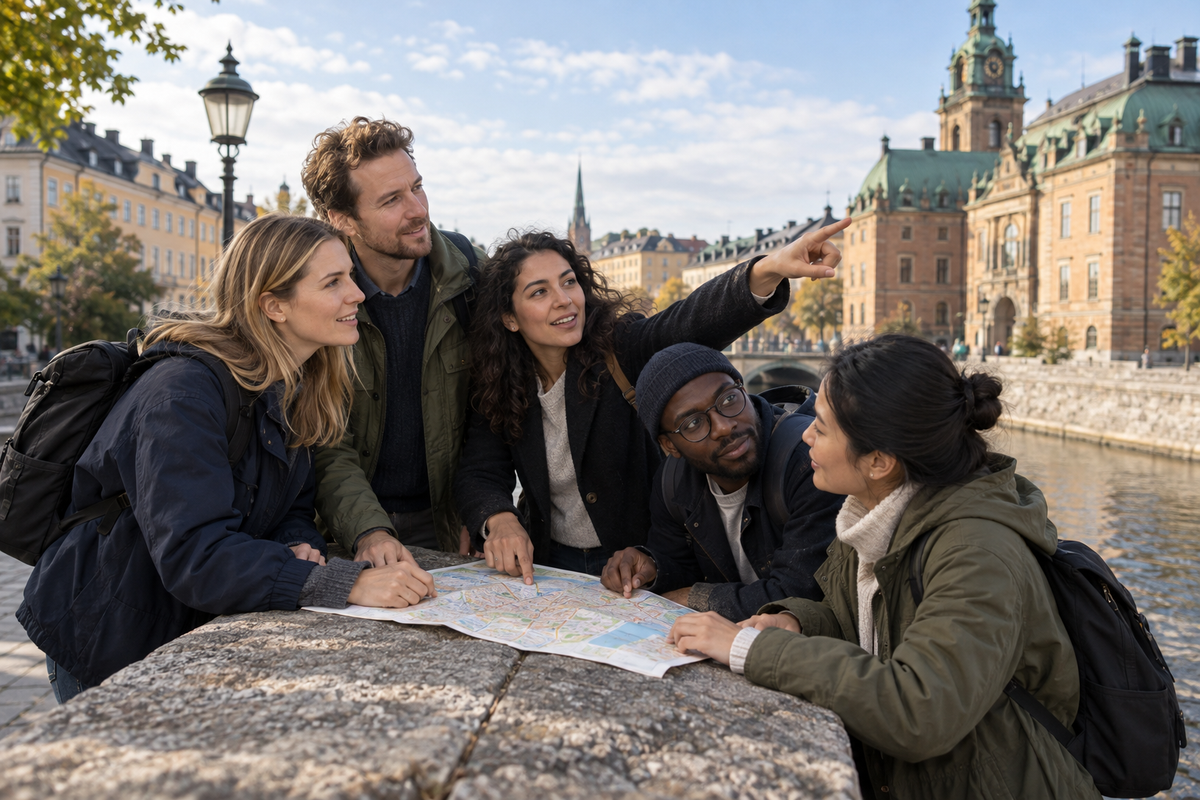
Teambuilding for a small team doesn't have to be a full day of lectures and competitive activities. Sometimes it's enough to get out of the office, work on a shared task and meet colleagues in a different setting. A self-guided mystery hunt can be one such activity. It still requires planning: everyone should understand what to expect and be able to participate on reasonable terms.
The mysteries in this guide


In this guide
Start with the participants' needs
Ask about needs regarding physical activity, reading, language and pace before booking the day. An outdoor game in an older urban environment is not automatically suitable for everyone. Contact us if the route itself needs to be assessed, rather than assuming it is accessible in a certain way.
Be clear about the purpose too. If the goal is to socialize and collaborate, you don't need to add points, timing and performance. For a smaller team, it can be valuable to work on a question that has nothing to do with their usual roles at work.
Choose a city and appropriately sized groups
There are games in Gamla stan, Haga, central Örebro and Wadköping. Choose a location that is easy to reach from your common starting point. The product page shows current information and the starting point.
If the team is larger than a small group, divide it into smaller groups with their own booklets. Everyone needs to be able to see the tasks and hear the story. Feel free to mix colleagues who do not work closely together every day, but avoid making the group division a major project in itself.
Appoint a coordinator, not a game master
Someone needs to keep track of the order, meeting time and where you meet afterwards. However, that person does not need to know the solutions or lead the game itself. The booklet and the Archive provide the instructions. This is not a staffed corporate event with Mysteriejakten staff on site.
Within the groups, you can alternate between reading, observing and suggesting answers. Feel free to ask the group to pause before the first theory becomes everyone's theory. This gives more people a chance to contribute, without having to turn the activity into a formal workshop.
Finish with a few simple questions
Gather the team over a coffee break or lunch that you arrange separately. Ask what helped the group move forward, when you got stuck and if anyone saw something that others missed. You do not need to translate every moment of the game into a lesson about work.
Order the booklets in advance, advise on dressing for the weather and remind everyone to bring fully charged mobile phones with internet access. Have a backup plan for unsuitable weather. For a larger or customized setup, you can contact us before finalizing the details. Also read our guide to group activities for more practical tips on meeting up and taking breaks.
The mysteries in this guide
Frequently asked questions
Is there a game master from Mysteriejakten on site?
No. The activity is self-guided. One person on the team needs to coordinate the order and meeting point, but the booklet and the Archive provide the instructions for the game.
How do we organize a larger team?
It is better to divide the team into small groups, each with their own booklet, rather than having everyone follow the same reader. Contact us before purchasing if you need help determining the number of booklets and practical arrangements.
What should we check to ensure everyone can participate?
Ask about needs regarding mobility, language, reading, and pace. An outdoor game in an older urban environment is not automatically suitable for everyone, so ask about the route itself if adaptations are needed.
What does the contact person need to arrange before the team activity?
Arrange the right number of booklets, allowing for a few extras, a clear meeting point, and information that the activity is outdoors. Also agree on how the cost and any meals will be handled.
How can the groups discuss the experience afterwards?
Gather everyone once the groups have finished and let them share what changed their theory or helped their collaboration. Avoid revealing answers to a group that is still playing.
How do we plan the time if the team is going to eat afterwards?
Start with the current product information and add time for meeting up, the groups' different paces, and breaks. Do not book the next part of the program so close together that participants need to rush through the tasks.


