

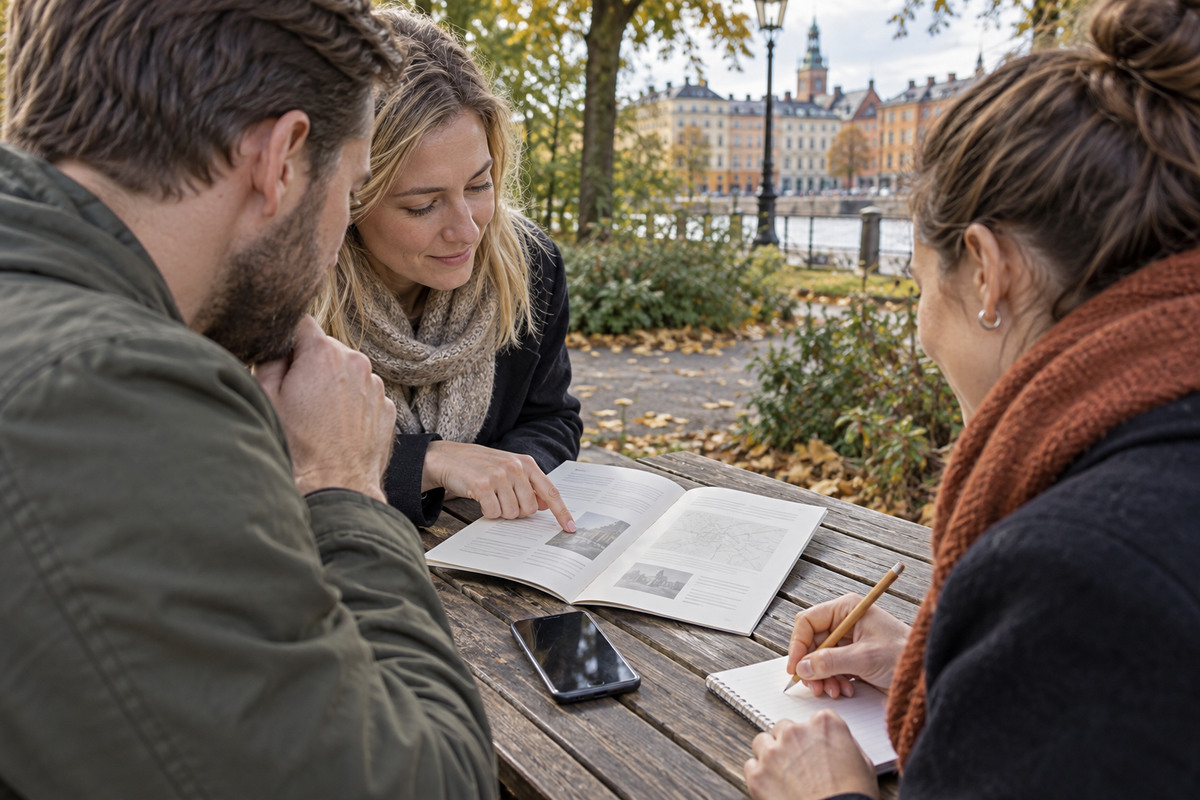
A murder mystery is a game where you investigate a fictional murder, compare clues, and try to find a solution. With Mysteriejakten, you do this outdoors on location with a physical booklet and the Archive on your mobile phone. You don't need a game master and can play as a small group, even with just two people. Here you get a beginner's guide without spoilers, so everyone can join in and solve your first case.
The mysteries in this guide


In this guide
Can two of us play without a game master?
Yes. You can share the reading, the map, and the mobile phone between you and discuss the same information. No one needs to know the solution in advance or play a predetermined role. Being two makes it easy for both of you to see the booklet, but you still need to give each other time to think.
This differs from some murder dinners and role-playing games, where an organizer may need to prepare roles or lead the evening. Mysteriejakten is a self-guided outdoor game, not a dinner package or a digital home murder mystery. Read the comparison between murder mysteries at home and outdoors if you are choosing between the formats.
Prepare the practicalities before you start thinking about the case
Choose a mystery that takes place in a location you can visit: Gamla stan, Haga, Örebro city center, or Wadköping. Read the product information and check the starting point. When you order online, the physical booklet needs to arrive before the day you plan to play.
Bring the booklet, a charged mobile phone with internet access, and preferably a pen. Choose clothes and shoes suitable for a walk with stops. If you need to assess the content or accessibility for anyone in the group, ask us before you order. Being prepared means you can focus on the game once you are at the starting point.
Read the question before you start looking
It is easy to see an interesting detail and immediately try to make it the answer. Start at the other end: read the task all the way through and formulate what you actually need to find out. Have someone repeat the instructions in their own words so that everyone is on the same page.
If the group gets stuck, go back to the wording before expanding the search. Have you followed the order in the booklet? Are you investigating the right thing? It is often more useful to clarify those questions than to collect more loose guesses.
Distinguish observations from theories
An observation is something you have actually read or seen. A theory is your explanation of how it all fits together. Keep them separate when you discuss. The person who proposes an answer can state what evidence the idea is based on, so that the rest of the group can follow the reasoning.
You do not need to agree from the start. Ask the person who has a different opinion to explain their path to the answer, instead of voting on who sounds most certain. Feel free to write down something brief to help you remember what you have already investigated, without turning the walk into an extensive protocol.
Switch roles so that everyone can contribute
If the same person is constantly reading the booklet, holding the phone, and proposing answers, the others will have less information to work with. Take turns reading, following the map, and using the Archive. Stop where the group can gather without blocking others.
Give each other time to think. The fastest theory does not have to be the best-founded, and the person who discovers something does not have to be the one who usually talks the most. For a larger group, there are more planning tips in the guide to activities with friends.
Use the help that comes with the game
When the booklet refers you to the Archive, follow the instructions there to test answers and move forward. Also read how the answer should be entered. If you need help, use the help the material refers to instead of searching for the answers online and risking having the rest of the story revealed.
A break can give you a new perspective. Finish reading the instructions, note where you should continue, and let everyone share what they are thinking. In the guide to fika and mysteries, there are tips for making the break part of the experience. If you want to understand the entire setup before purchasing, you can read how a city mystery works.
The mysteries in this guide
Frequently asked questions
What is a murder mystery?
It is a game where participants investigate a fictional murder, compare information and try to solve the case. The city mysteries in Mysteriejakt are played outdoors on location with the booklet and Arkivet on your mobile phone.
Can two people play the murder mystery?
Yes. A small group can play together, even two people. Take turns with the booklet and mobile phone and read the relevant product information for the mystery you choose.
Does one of us need to be the game master?
No. No one needs to know the solution or prepare a role. You follow the booklet and Arkivet together. However, someone needs to arrange the order and the meeting.
Do we need to be experienced detective readers?
No. Start by reading the instructions carefully and sharing the information. Distinguish between what you actually know and what you assume, so that everyone can follow the reasoning.
What do we do if we get stuck on a task?
Read the wording of the task again and compare your observations. Use the help referred to in the booklet and Arkivet and follow the instructions on how to enter the answer.
Can we start right after an online purchase?
First, plan for the delivery of the physical booklet. Arkivet is used together with the material and does not make the entire game an immediate digital delivery.


